Nvidia Unveils New AI Chip to Power Next-Gen Machine Learning Models

Editor
. 2 min read

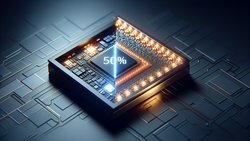
Nvidia's latest AI innovation, the Blackwell B200 chip, promises to supercharge the training of machine learning models by a remarkable 30% over its predecessors. The announcement came from CEO Jensen Huang at a bustling conference in San Jose, California, and it's causing quite a stir in the tech world.
Why does this matter? Well, faster training times mean quicker deployment of AI solutions across industries. Nvidia's new chip is poised to accelerate advancements in sectors from autonomous vehicles to healthcare diagnostics.
The Blackwell B200, priced at $30,000 per unit, is set to enter mass production by the first quarter of 2025. Huang confidently stated, "This chip will redefine how fast and efficiently AI models can be trained." This bold claim positions Nvidia at the forefront of the AI hardware race.
Key Players and Reactions
Microsoft and Amazon Web Services are among the first to express interest in adopting the Blackwell B200 for their AI operations.
According to a report by Gartner, the AI hardware market is set to reach approximately $50 billion by the end of 2025, highlighting the strategic timing of Nvidia's release.
Industry insiders believe that the improved performance of the Blackwell B200 could lead to significant cost savings in data centers, where energy efficiency and speed are paramount.
Broader Impact
For tech giants, incorporating Nvidia's latest chip could mean maintaining a competitive edge in a rapidly evolving market. Startups and smaller companies may also benefit from the trickle-down effect as these chips become more accessible over time.
Nvidia's dominance in AI hardware isn't new. The company has consistently pushed the envelope, with its earlier models setting the bar for performance. The introduction of the Blackwell B200 is yet another step in this ongoing journey, reinforcing Nvidia's role as a leader in AI innovation.
As the demand for AI-driven solutions grows, the need for more powerful and efficient chips like the Blackwell B200 becomes increasingly critical. This development not only supports advanced research but also fuels consumer applications, potentially transforming everyday technology use.
Historical Context
Nvidia's history of AI chip development is marked by milestones like the Volta and Ampere architectures, each raising the stakes in the AI industry. The Blackwell B200 is a continuation of this legacy, promising to push boundaries even further.
Sources - Reuters - Gartner, "AI Hardware Market Forecast", 2023

More Stories from
NVIDIA’s Latest GPU Architecture Promises 50% Faster AI Training for Enterprises
NVIDIA unveils Hopper H200 GPU, cutting AI training time by 50%, launching January 2025.
IBM’s Quantum Computing Breakthrough Promises Faster AI Training
IBM's new quantum processor, Heron, promises to accelerate AI training by up to 3x, revolutionizing industries reliant on complex computations.

MIT Researchers Develop Breakthrough Quantum Computing Algorithm for Faster Data Processing
MIT develops a quantum computing algorithm reducing data processing times by 40%, potentially revolutionizing tech industries.

NVIDIA’s Latest GPU Architecture Promises 50% Performance Boost for Machine Learning Tasks
NVIDIA's Hopper H200 GPU offers a 50% boost in machine learning performance, set to impact AI innovation.
NVIDIA Announces Breakthrough in Machine Learning Chips, Promises 50% Energy Efficiency Gain
NVIDIA unveils H200 chip with 50% energy efficiency gain, redefining AI computing.